
A good blazer should button without a fight. The best plus-size blazers that actually close give you room across the bust and belly, buttons that sit flat instead of pulling, and enough structure to look sharp worn open or shut. Here’s how to spot one before it ships.
Why so many blazers won’t close on a curvy body
You know the scene. The shoulders fit. The sleeves are right. Then you reach for the button and the two fronts just wave at each other from a distance.
That gap isn’t your body failing the jacket. Most blazers are drafted from a straight-size block, then scaled up. Scaling adds width everywhere in equal measure, but curves don’t grow that way. Bust, belly, and hips each need room in different places.
A blazer cut for curves does that work on paper first. It adds shaping at the waist, room through the front, and a button placed where your body actually bends. Small drafting choices, huge difference on your torso.
The closure test: what to check first
Forget the size label for a second. Run these checks in the fitting room, or the minute a delivery lands on your doorstep.
Button it standing up, arms relaxed. The fronts should meet without you holding your breath or tugging them together. If you have to pull, it’s too small across the front — no matter what the tag says.
Now sit down. A blazer that closes standing but strains seated will spend its life unbuttoned in a drawer. Sit, cross your legs, reach forward like you’re grabbing your bag. The button should stay calm through all of it.
Watch the button, not the mirror
A straining button tells the truth fast. Look for horizontal pull lines radiating from the closure, a lapel that flips outward, or a vent at the back that splays open.
One more tell? The fabric between the button and the side seam goes tight and shiny. That’s strain, and strain means the next size up — or a different cut entirely.
Measure yourself before you shop
Grab a soft tape and three numbers: fullest part of your bust, your natural waist, and your hips. Measure over the kind of top you’d actually wear under a blazer, not over bare skin and not over a chunky knit.
Then compare those numbers to the brand’s size chart — the garment measurements, not just the size names. A size 22 in one label can be cut closer than a size 20 in another.
Here’s the rule that saves returns. If your bust and waist land in different sizes, shop for the larger one and let a tailor take in the rest. Letting a blazer out is rarely an option. Taking one in is routine work.
The two-finger trick
Button the blazer and slide two flat fingers between the button and your body. Room for two fingers means room to move, eat lunch, and live your day.
No room at all? That’s a strain fit. A whole fist of space? You’ve likely gone a size too far, and the shape will swallow you.
Which cut closes best on your shape?
Not every blazer style treats curves the same way. Single-button cuts forgive more around the middle. Double-breasted styles need more front room to close cleanly, but they reward you with a strong, polished line.
Use this table as a starting map, then trust your own closure test over any chart.
| Blazer style | Closes best if you… | Watch out for | Best occasion |
|---|---|---|---|
| Single-button, nipped waist | Carry weight at the bust or belly | Button set too high can pull | Work, meetings, polished everyday |
| Double-breasted | Want structure and a defined shape | Needs the most front room of any cut | Evenings, formal days, sharp tailoring |
| Relaxed boyfriend cut | Prefer ease through the hips | Can look boxy if the shoulder is too wide | Weekends, denim, creative offices |
| Longline blazer | Want coverage past the hip | Check the vent doesn’t splay when buttoned | Dresses, leggings, layered looks |
| Open-front (no closure) | Love the blazer look without buttons | It never truly closes — that’s the design | Casual layering only |
See that last row? An open-front blazer can be lovely, but it isn’t a closing blazer. If warmth or coverage is the job, pick a cut with a real button and a front that was drafted to meet.
Fabric and details that help a blazer close
Fabric does quiet work here. A touch of stretch — look for elastane listed on the label — lets a front settle over curves instead of fighting them. Ponte and crepe with stretch tend to be kind. Stiff, unyielding suiting can feel like armor in the wrong size.
Lining matters too. A smooth lining helps the blazer glide over your top instead of grabbing it. Grabbing fabric adds fake tightness that has nothing to do with fit.
Details worth hunting for
- A button placed at your natural waist, or just below it — that’s where a closure works with your shape instead of against it.
- Princess seams or back darts, which build in curve room rather than adding bulk.
- A back vent that lies flat while buttoned, a quick honesty check on hip room.
- Sleeves you can push up without the whole front shifting — a sign the armhole was cut for movement.
Shoulder seams deserve one glance. The seam should end at your shoulder point. If it droops past it, the whole front hangs wrong, and even a roomy blazer can look like it doesn’t fit.

Styling a blazer that fits — closed and open
A blazer that closes gives you two outfits in one garment. Buttoned, it’s the outfit: sharp over a dress, clean with tailored trousers, instantly more put-together than the pieces underneath deserve.
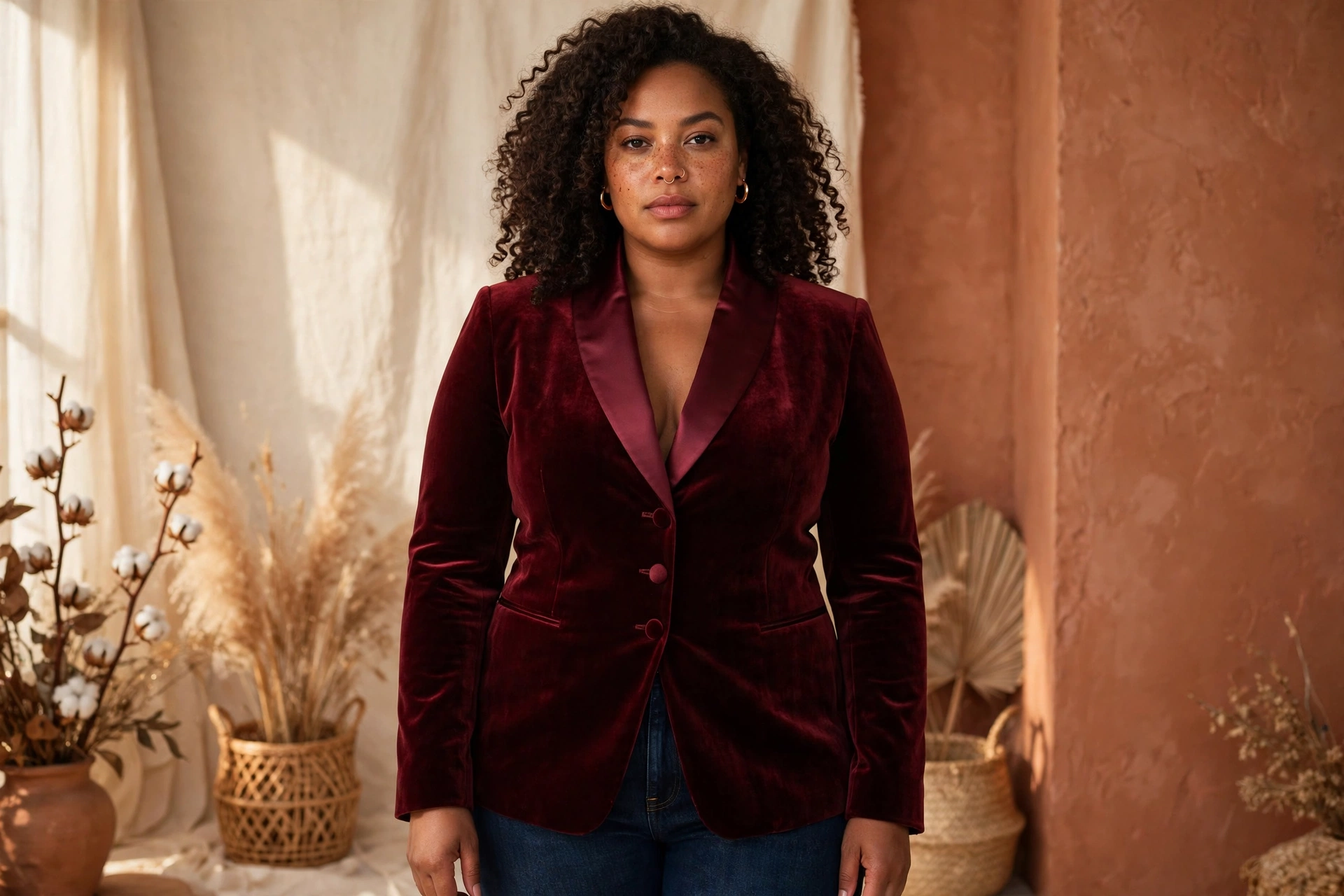
Try an emerald or burgundy blazer, closed, over dark denim and a simple top. The color does the talking. The closure does the shaping. You’re done in five minutes.
Open, it frames what’s under it. That’s your moment for a bold print blouse or a graphic tee. Let the inside have the fun and keep the blazer as the frame.
Three styling moves that always land
- Closed over a slip dress for evening — add a heel or a sleek boot and skip the necklace; the lapels are the jewelry.
- Open over denim-on-denim, with the blazer in a jewel tone to break up the blue.
- Belted over the closed front on a longline cut, if you want extra waist definition for a night out.
Sleeve length bugging you? Push them to the forearm. It’s practical, it shows the lining if there’s a fun one, and it makes a structured piece feel like yours instead of borrowed.
When to tailor, when to walk away
A tailor can shorten sleeves, nip a waist, and clean up a hem. That’s money well spent on a blazer that already closes well.
What a tailor can’t do is invent front room that isn’t there. If the button strains on day one, no alteration fixes it. Walk away, or size up and tailor down.
Buy for the body you have today, in the size that closes today. A blazer that fits now gets worn now — and a blazer that gets worn is the only kind worth closet space.
Bottom line
The right plus-size blazer closes without pulling, sitting, reaching, or negotiating. Shop your largest measurement, run the sit-down test, and let the button tell you the truth. Pick the cut that suits your shape, tailor the small stuff, and wear it buttoned with confidence. You deserve a blazer that meets you in the middle — literally.